- Start by defining a task participants should be able to perform after the workshop, then design an activity and a clear standard for assessing it.
- Keep the explanation that serves performance, and leave time for attempts, feedback and improvement instead of presenting every slide.
- A game or a short discussion does not make a lecture practical; what matters is what participants do and what they learn from the result.
What is the first question before you edit the slides?
Ask: what should participants be able to do at work that they cannot do now to the required standard? If the goal is preparing a report, they should leave having practised a report; if the goal is conducting an interview, they should practise an interview or a suitable part of one. Do not start by cutting slides before defining the performance, or you may remove necessary information and keep explanation that does not serve the task.
Training quality standards stress consistency between objectives, content, interaction and assessment, and adult learning guidance highlights the value of methods that give participants an active role beyond listening. But the activity has to suit the learners and the context, and there is no single recipe that turns every topic into a workshop to the same degree. Some knowledge needs explaining first, and then application checks that it can be used. [1, 2]
How do you choose a realistic, contained task?
Choose a task that can be completed and reviewed within the available time, and that involves a meaningful decision or performance. Do not give a beginner group a huge project that requires knowledge they have not yet learned. The task can be split into stages: reading the case, identifying the problem, producing an output and reviewing it. This is a suggested design structure, not a mandatory template for every programme.
Provide enough information without overload: a short context, the necessary documents, clear constraints and what must be handed in. If the case is hypothetical, say so, and do not attribute it to a real client. If you draw on a real case, check permission and confidentiality and remove data the learning does not need. A good case comes from decision logic that resembles the work, not from lots of detail or sensitive names.

How do you define success before the activity starts?
Write down what the trainer will look for in the output. In training on a management report, that might include a clear question, a distinction between data and conclusions, and a recommendation that can be acted on. These are illustrative criteria for the example, and they can be turned into a checklist participants see before they start. When learners know the quality standard, they can organise their effort and assess their own attempt instead of waiting for the trainer’s taste at the end.
Guidance on learning objectives helps describe observable performance, its conditions and its acceptance limits. Do not let objectives become a list of scientific-sounding verbs with no link to an activity or assessment. If an output cannot be assessed within the workshop, explain what will be checked during it and what will need further practice at work, rather than claiming that everyone mastered it simply by attending. [3]
How much explanation do participants need?
Start with what enables them to try: a core concept, a worked example and a common mistake, then give them room to apply it. When a shared difficulty appears, give targeted explanation rather than repeating the whole lecture. Some background can move into a short reading if that suits the group and you can check it was read and understood, not as a token fix for lack of time.
There is no fixed ratio of explanation to application that suits every topic. The balance depends on the complexity of the task, participants’ experience and how serious a mistake would be. Training on a new skill may need a clear demonstration before practice, while an experienced group needs a more complex case and a discussion of evidence. Watch the quality of the attempts and adjust the pace, rather than sticking to a number of slides fixed before you knew the group’s level.
How do you give feedback that changes the next attempt?
Link each comment to a clear standard and a specific place in the output. Instead of “the presentation is weak”, say that the recommendation does not state who will carry it out or what evidence it rests on. Then ask the participant to improve that part. Do not turn feedback into a judgement on the person or an embarrassing comparison between participants; the aim is for them to know what to change and how to check that the work improved.
Peer review can be used when the standards are clear and the task suits it, with the trainer remaining responsible for correcting content. Do not assume that exchanging views guarantees correct content. If an inaccurate answer appears, correct it respectfully and explain why. Training quality standards stress providing opportunities for participation and feedback, not just asking at the end whether there are any questions. [1]
How do you manage group work so one person does not do it all?
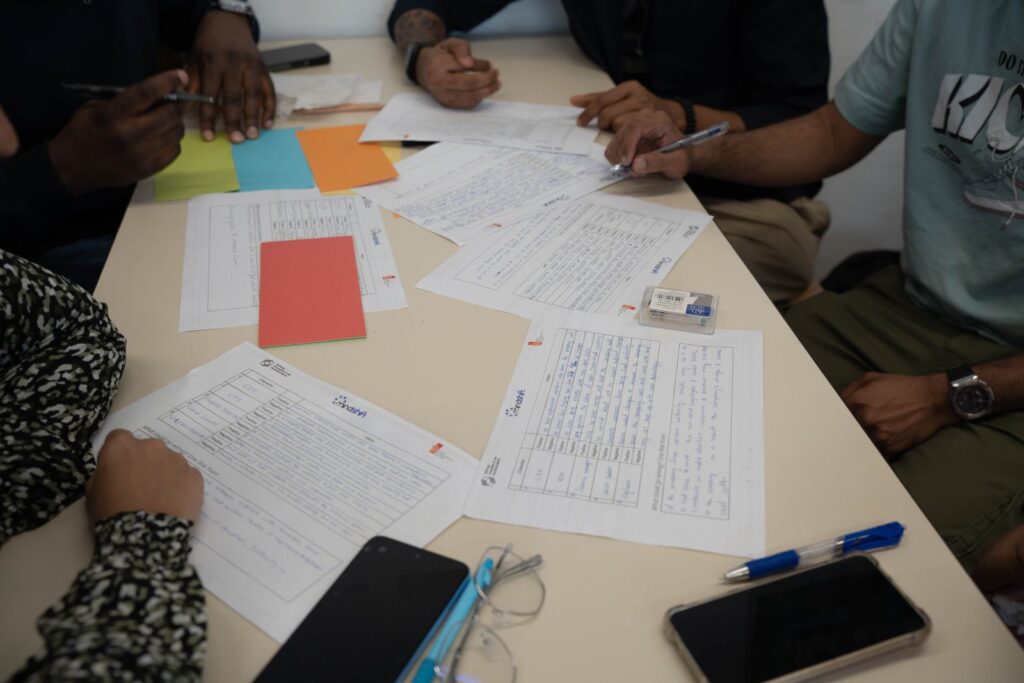
Set roles or outputs that make participation visible, such as analysing one part and then discussing the choice together. Watch who speaks, who writes and who needs support, and do not always read silence as lack of interest. Some participants need time to think or a different way of contributing. Combining a short individual attempt with group work stops individual learning gaps disappearing inside the group’s performance.
In remote workshops, test tools, files and permissions before starting, and explain what happens if someone cannot join a breakout room or open a document. Do not make learning a new platform an unstated condition for learning the actual topic. Provide a suitable alternative to technical activities where possible, and review accessibility and language needs for the group. These details affect whether people can actually take part more than the look of the presentation does.
What does converting a lecture look like in a hypothetical case?
Take a lecture on writing work reports. Instead of explaining every type of report, the workshop chooses the task of preparing a recommendation from a limited set of hypothetical data. The trainer shows an example that separates fact from conclusion, then participants work on a new case, using a checklist to examine the evidence, clarity and responsibility. After feedback, they rewrite the part that needs improving.
The workshop’s quality is not measured by the number of pages produced, but by whether participants can explain why they changed their recommendation and how they supported it with evidence. Back at work, they are asked to choose a suitable report to apply the method to, in line with their organisation’s policy and privacy rules. This is a suggested teaching case and makes no claim that a particular method raised performance by a set percentage or succeeded with a real client.
How do you support transfer of learning to work in the Gulf?
Choose examples and procedures close to the organisation’s sector, taking regulatory and language differences into account. Do not present a foreign template as a binding local procedure, and do not turn examples into generalisations about a whole country’s culture. If participants come from different organisations, explain that templates need adapting to each organisation’s authorities, especially in contracts, HR and regulated sectors.
Agree suitable follow-up support with the training manager: a job aid, an application task, a review session or follow-up by the line manager. Quality standards point to the importance of post-training support, but the choice of method follows the resources and the need. Do not send participants extra tasks without telling them how they will be reviewed or how they relate to their work; an assignment nobody follows up can become a burden rather than a learning opportunity. [1, 4]
How do you pilot the workshop before delivering it?
Ask a group that represents the audience to carry out the activity using the proposed instructions and materials. Watch the timing, the questions and where people get stuck, and do not jump in to explain what the handout should have made clear. Separate intended difficulty that serves learning from unintended ambiguity in the data.
Compare the size of the output with the time available for feedback. If participants produce work the trainer will not be able to review, reduce the scope or split it into stages. Check files, links and permissions again before delivery, with a fallback where the activity allows.
Record your changes and the reasons for them, and keep a clear version of the materials. A substitute trainer needs to understand the logic of the activity, the review standards and the expected mistakes, not just the slides. This documentation means quality does not depend on the designer’s memory, and supports consistent delivery while leaving room to adapt examples. You can also collect participants’ comments on how clear the instructions were, how hard the task was and whether the time was right, then compare them with the evidence of performance. If they say the activity was easy while serious mistakes appeared, they may need the quality standard explained rather than a harder activity. If mistakes came from missing basic information, fix the materials instead of reading it as a lack of ability.
Frequently asked questions
Do I need games and competition?
No. Reviewing a document or making a decision in a case may be more useful. Choose the activity based on the objective, not on how much movement or laughter it creates in the room.
What if the group is large?
Design activities and outputs that suit the numbers, and provide assistants or enough review time where needed. Do not promise in-depth individual feedback if resources do not allow it.
Does a group output prove that each individual learned?
Not on its own. Add a suitable individual check, such as explaining a decision or carrying out part of the task, so one member's performance is not credited to everyone.
Is satisfaction enough evidence of learning?
No. It helps improve the experience, but acquiring a skill needs evidence of performance or an assessment suited to the objectives, within the limits of what can be observed in a workshop.
What is the first change to make to my current lecture?
Pick one important output, build an activity, a review standard and a chance to improve around it, then rearrange the explanation around that. Test this version before converting the whole programme.
References
Recommended programmes