- HACCP is built on good hygiene practices and does not work if basic hygiene and training are weak.
- The seven principles become a working plan once every critical control point has a measurable limit, monitoring and a pre-defined corrective action.
- Critical limits for cooking, cooling and holding differ between regulators, so use the figures set by the competent authority in your emirate or country.
The figures quoted are illustrations from the Dubai Municipality Food Code; every establishment must follow the requirements of its own competent authority.
What is HACCP and why does it start with hygiene?
Hazard Analysis and Critical Control Point (HACCP) is a systematic approach to identifying, evaluating and controlling hazards to food safety. Those hazards are of three kinds: biological, chemical and physical. [3, 6]
The Codex Alimentarius sets out the system within the General Principles of Food Hygiene, CXC 1-1969, adopted in 1969 and most recently revised in 2022. [1] The key idea is that HACCP does not stand alone: good hygiene practices (GHPs) are prerequisite programmes that must be firmly in place before it is applied, together with management commitment. [2, 4]
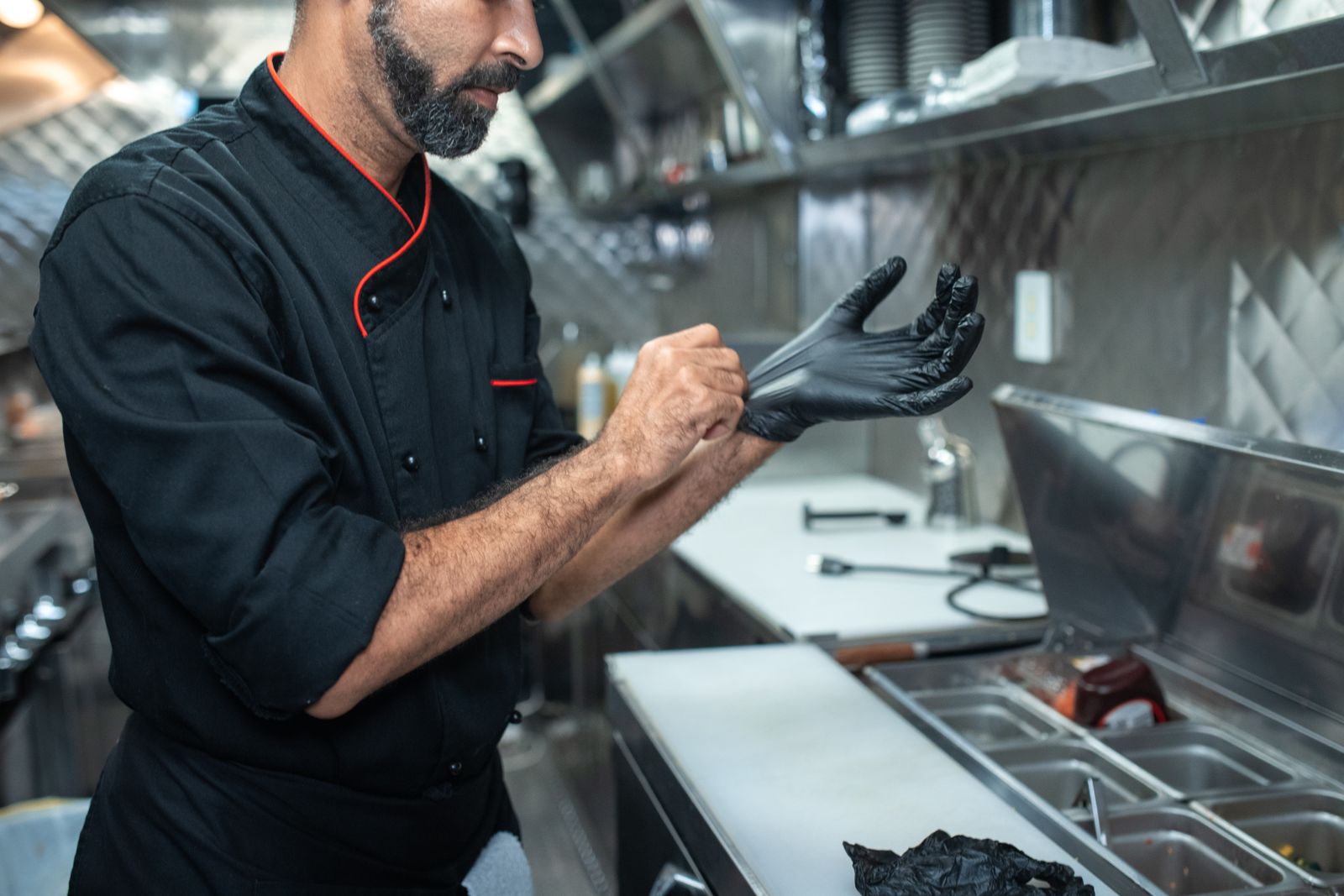
Put practically: if handwashing, cleaning, pest control and separation of raw and cooked food are weak, no HACCP plan will save you, however well it is written.
The seven principles at a glance
- 1Hazard analysisAnd identify control measures
- 2Critical control pointsWhere the hazard must be controlled
- 3Critical limitsMeasurable, validated criteria
- 4MonitoringPlanned measurement or observation
- 5Corrective actionWhen a limit is breached
- 6Validation and verificationEvidence and review
- 7DocumentationProcedures and records
These principles are applied within a sequence of 12 steps. The first five are preliminary: assemble the HACCP team and define the scope, describe the product, identify the intended use and users, construct a flow diagram, and confirm it on site. Steps 6 to 12 are the seven principles in order. [2]
Before the analysis: team, product and flow diagram
The team: people who genuinely know the products and processes, such as the head chef, the food safety officer and the maintenance lead. Outside expertise can help, but the plan must reflect how the kitchen actually works. [2, 4]
Product description and intended use: ingredients, preparation method, storage, shelf life and who will eat it. [2] A dish served in a hospital or nursery reaches more vulnerable groups than one served in a public restaurant.
Flow diagram: map every step from receipt to service, then walk the kitchen and compare the diagram with what actually happens, across more than one shift. This fifth step uncovers many differences between paper and practice. [2]
Hypothetical example: chicken curry prepared in advance
A central kitchen cooks chicken curry in the morning, cools and stores it, then reheats and hot-holds it for lunch service. The flow diagram:
- Receipt of chilled chicken.
- Chilled storage.
- Preparation and cutting.
- Cooking.
- Rapid cooling.
- Chilled storage of the cooked dish.
- Reheating.
- Hot holding and service.
Hazard analysis and identifying CCPs
For each step the team asks: what hazard could occur? Is it significant, meaning reasonably likely to reach an unacceptable level without control? And what is the control measure? [3]
The analysis is not limited to bacteria. Chemical hazards, such as cleaning chemical residues, and physical hazards, such as bone fragments or glass, belong in the same analysis, even if in this example they are controlled through hygiene practices.
| Step | Main hazard | How it is controlled |
|---|---|---|
| Receipt and chilled storage | Bacterial growth if temperature rises | GHP: temperature check on receipt, fridge operation |
| Preparation | Cross-contamination from raw chicken | GHP: separate utensils and surfaces, handwashing |
| Cooking | Survival of pathogenic bacteria | Critical control point |
| Cooling | Bacterial growth in the danger zone | Critical control point |
| Reheating | Survival of bacteria that grew during storage | Critical control point |
| Hot holding | Growth if temperature falls | Temperature control plus a time rule for discarding; the team may treat it as a CCP |
Note that not every hazard needs a CCP. Cross-contamination is controlled mainly through hygiene practices; a CCP is reserved for a step where the control measure is essential. [3] The revised Codex text added new tools, including an annex, a figure and a table, to help identify CCPs. [1]
Critical limits, monitoring and corrective action
A critical limit is a measurable or observable criterion that separates acceptable from unacceptable food. [3] In kitchens it is usually a combination of temperature and time. The Dubai Municipality Food Code, for example, requires raw animal foods to be cooked to a core temperature of at least 75°C; food to be cooled from 60°C to 20°C or below within two hours and then to 5°C or below within a further four hours; food reheated for hot holding to exceed 75°C within one hour; and hot food to be held at 60°C or above. [5]
| CCP | Critical limit | Monitoring | Corrective action |
|---|---|---|---|
| Cooking | Core at least 75°C | Calibrated probe, every batch | Continue cooking until limit reached |
| Cooling | 60°C to 20°C within 2 hours, then to 5°C within 4 more | Timed, recorded readings | Discard batch as the plan specifies |
| Reheating | Above 75°C within 1 hour | Reading for every batch | No hot holding until limit reached |
Monitoring is a planned series of measurements: who measures, with what device, when, and where it is recorded. The Code requires cooking temperatures to be checked with a calibrated thermometer at the slowest-heating point, usually the core, and the readings recorded. [5]
Corrective action is written in advance, not improvised when something goes wrong. It covers restoring control, dealing with the affected product and preventing recurrence. [3] On cooling specifically, the Code states that reheating does not make improperly cooled high-risk food safe. For hot holding, it requires hot high-risk food held between 5°C and 60°C for more than two hours to be discarded. [5]
Verification and records: what proves the plan works?
Validation answers the question: is the critical limit actually capable of controlling the hazard? Verification answers: are we applying the plan as written? [3]
Practical verification in a kitchen includes:
- The supervisor reviewing and signing cooking and cooling records daily.
- Calibrating thermometers at a set frequency. [5]
- Comparing cooling records with blast-chiller capacity when volumes increase.
- Reviewing the plan when the menu, equipment or supplier changes.
Documentation covers the plan itself, the hazard analysis and the records of monitoring, corrective action and verification; this is the seventh principle. [2]
Mistakes that recur in kitchens
- Records without decisions: an out-of-limit reading is logged with no documented corrective action beside it.
- Copied plans: a generic plan adopted without confirming the flow diagram on site.
- Too many CCPs: turning every step into a CCP dilutes attention from the points that actually protect the consumer.
- Uncalibrated equipment: an inaccurate thermometer makes every record worthless.
What do Gulf regulators require?
Requirements vary by country, emirate and type of establishment, so do not assume that what applies in one city applies in another:
- Dubai: the Food Code requires all food establishments to implement a Municipality-approved food safety programme based on HACCP principles and to employ a Person in Charge certified in food safety, who must be present on every shift in food service establishments preparing high-risk, ready-to-eat or raw foods. [5]
- Saudi Arabia: the Saudi Food and Drug Authority (SFDA) guide requires food facilities under its supervision, such as factories, warehouses and distribution centres, to appoint a food safety officer, and for factories the officer must have training in quality management systems, food safety (ISO 22000) and HACCP. [6]
In Abu Dhabi and the other Gulf states, and for restaurants in Saudi Arabia, check the requirements of the competent food control authority for your area before fixing the critical limits in your plan.
Conclusion
HACCP is not a file prepared for the inspector; it is a way of identifying the few moments where, if control fails, food becomes dangerous. Secure hygiene practices first, map the flow as it really happens, give every CCP a limit, monitoring and a written corrective action, and review the records every day.
Frequently asked questions
What is the difference between good hygiene practices and a critical control point?
Good hygiene practices are basic measures applied throughout food handling, such as personal hygiene, cleaning and pest control. A critical control point is a specific step where a control measure essential to managing a significant hazard is applied. [3]
What is the difference between validation and verification?
Validation is gathering evidence that a control measure can control the hazard if properly applied; verification uses tests and reviews in addition to monitoring to confirm it is actually working as intended. [3]
Does a small restaurant need a full HACCP plan?
FAO guidance allows HACCP principles to be applied flexibly, including using external resources or adapting a generic plan to the business, but what is mandatory is set by the local regulator. [4]
Can food that was not cooled properly be made safe by reheating?
Do not rely on it. The Dubai Food Code states that reheating does not make improperly cooled high-risk food safe. [5]
Who writes the HACCP plan in a kitchen?
A team of people who know the products and processes, such as the head chef and the food safety officer, with outside expertise if needed, while responsibility stays with the establishment's management. [2, 4]
References
- FAO/WHO Codex Alimentarius Commission, Japan Food Hygiene Association edition. General Principles of Food Hygiene CXC 1-1969 (bilingual edition) (2022)
- Food and Agriculture Organization of the United Nations (FAO). Introduction to Hazard Analysis and Critical Control Point (HACCP) (2023)
- Food and Agriculture Organization of the United Nations (FAO). GHP and HACCP Toolbox for Food Safety: Glossary
- Food and Agriculture Organization of the United Nations (FAO). GHP and HACCP Toolbox for Food Safety: HACCP introduction
- Dubai Municipality, Food Control Department. Food Code
- Saudi Food and Drug Authority (SFDA). Food Safety Officer Requirements Guide (2025)