
- Separate what you know from what you assume, then focus verification on the assumption that would change the decision if it changed, rather than treating every unknown equally.
- Sensitivity analysis and a switching value show how wrong an assumption can be before the chosen option stops being worthwhile.
- When learning costs less than committing, trial on a small scale with conditions for scaling up or stopping written in advance, and record what was known at the time of the decision.
Why do good decisions on paper fail?
Many decisions fail not because the analysis was weak, but because one untested assumption was carrying the whole decision. HM Treasury’s Green Book, the UK government’s guidance on appraising options, acknowledges that evidence is often incomplete or inconclusive, and asks appraisers to communicate the sources of uncertainty clearly rather than hiding them behind a single number. [1]
Although the guidance is written for UK public spending, its logic applies to any leader making an operational decision: opening a branch, extending service hours, changing a procedure or buying a system. The core idea is simple: before you commit, know what your decision depends on and how wrong you could be.

How do you separate facts from assumptions?
Write two columns: what we know with evidence, and what we assume. “Monthly enquiry volume” is a fact if it is recorded; “half of those who enquire will come in the evening” is an assumption. Teams often discover at this step alone that the most important inputs to the decision are assumptions nobody has checked.
Then classify each assumption by two questions: what is its impact on the outcome if it is wrong, and how strong is the evidence for it? A high-impact, weakly evidenced assumption is where verification time should go. An assumption that would not change your choice even if it changed does not deserve much effort.
- 1Separate factsWhat we know versus what we assume
- 2Rank assumptionsBy impact and weakness of evidence
- 3Test sensitivityAnd calculate the switching value
- 4Imagine failurePlausible causes before deciding
- 5Trial smallWith written scale and stop rules
- 6Record and reviewWhat we knew, when we review
Sensitivity analysis and switching values: how wrong can we be?
The Green Book asks for sensitivity analysis on key assumptions, such as costs, and the calculation of switching values: the value a key assumption would need to reach for an option to stop being value for money. [1] The practical question it answers is: how far off can our estimate be before the decision becomes the wrong one?
If the decision remains worthwhile even if expected demand halves, you have a robust decision. If a small fall reverses the result, the decision needs more verification or a trial before commitment.
You do not need a complex financial model for this. For many operational decisions, a simple table is enough: the team changes one assumption at a time and checks whether the chosen option is still the best. When several assumptions move together, for example costs rising while demand falls, write one or two scenarios that combine those changes, and ask whether the decision holds in them or needs a fallback plan ready.
The Green Book also warns about optimism bias, and asks appraisers to adjust explicitly by increasing estimates of costs and durations and decreasing estimates of benefits. [1] The team most enthusiastic about an option is the one least able to see this bias in its own numbers.
The premortem: ask how we failed before we start
One tool for surfacing hidden assumptions is what Gary Klein described in Harvard Business Review as the “premortem”: the team assumes the project has just failed and generates plausible reasons for its failure. Klein argues that this lets those with reservations speak freely at the outset. [2] Asking each member to write their reasons down individually before the discussion, then revising the plan in their light, keeps the exercise from being dominated by the loudest voices.
What comes out of such a session is often assumptions missing from your log: dependence on a single supplier, another body’s approval, or the capacity of a team that is already stretched. Add them to the log and classify them like the rest.
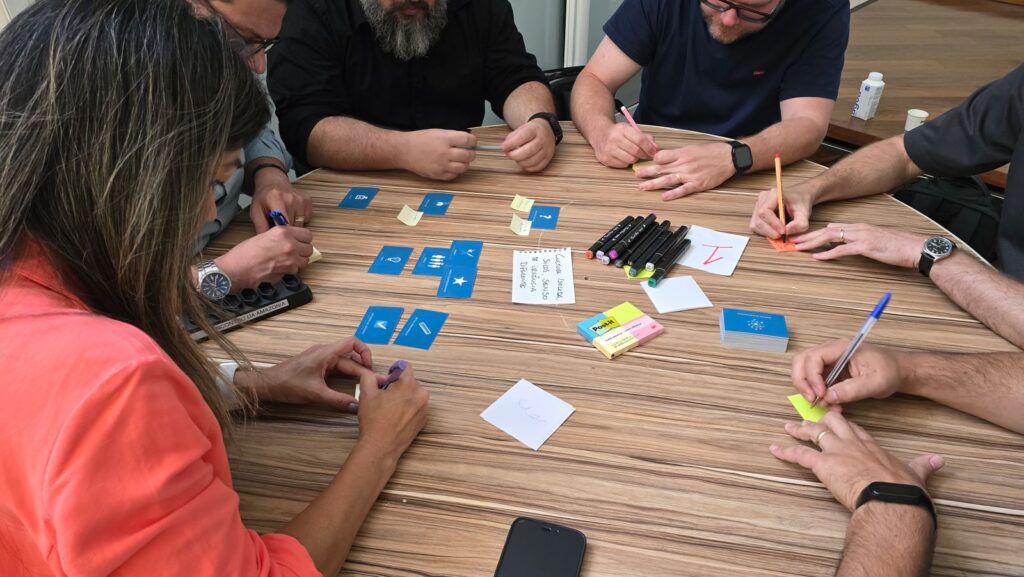
When should you trial on a small scale instead of committing fully?
Not all decisions are equally hard to reverse. In his letter to shareholders about 2016, Jeff Bezos described many decisions as reversible “two-way doors” that can use a light-weight process because being wrong costs less, and argued that most decisions should probably be made with around 70% of the information you wish you had, since waiting for 90% usually means being slow. [3] By the same logic, a decision that is hard to reverse deserves more scrutiny and a more senior approver.
When learning costs much less than committing, a limited trial becomes the sensible option. The Green Book lists an initial pilot and a phased rollout among implementation choices, and asks that evaluation be considered from the outset rather than after delivery. [1] The condition is that three things are written down before the trial: what we will measure, when we will scale up and when we will stop.
Hypothetical example
The manager of a service centre was considering extending opening hours into the evening. Enquiry volume was known, but the share of people who would actually come in the evening was not. As an illustrative input, the team estimated that the service would justify its cost if it served at least 15 customers per evening, the switching value, while enquiry volume suggested around 25. Because the estimate of 25 rested on weak evidence, the manager decided to trial evening opening at one branch for six weeks, and wrote down in advance: we scale up if the average exceeds 15 without longer morning waiting times, and we stop if it stays below that for four consecutive weeks.
| Assumption | Current evidence | What would change our view? | Review |
|---|---|---|---|
| Evening demand is sufficient | Enquiry volume only | Average below 15 per evening | Weekly during trial |
| Extra cost is limited | Estimated staff hours | Exceeding approved budget | Month end |
| Morning shift is unaffected | No evidence yet | Longer morning waiting times | Weekly |
Mistakes that undermine assumption testing
Even a team that follows the steps above can make mistakes that turn the test into a formality:
- Testing what is easy to measure, not what matters: the team gathers plenty of data on a low-impact assumption and leaves the decisive one because it is hard to measure.
- A trial with no stop condition: if it is not written in advance when the trial ends, it often becomes a permanent commitment by habit, or is extended every time the results come in weak.
- A trial in the best conditions: choosing the busiest branch or the most enthusiastic team gives a result that will not repeat when you scale up. Choose a site that represents the usual case.
- Changing the yardstick after the result: if the result falls below the agreed threshold, the idea’s sponsors tend to look for another measure that looks better. The threshold written in advance is what protects against this.
- A single number instead of a range: presenting one estimate hides uncertainty; it is better to show a low and a high figure with the assumptions behind each.
How do you keep the decision open to review?
Keep a short decision record stating what was known at the time, the options considered, why the chosen option was preferred, the assumptions it rests on, and the signals that would trigger a review and when. In government and semi-government bodies in the Gulf, where decisions are subject to internal audit and oversight, such a record makes the decision easier to defend because it shows it was reasonable given the information available. The record need not be long: a single page is usually enough for operational decisions, provided it is kept where whoever reviews the decision later can find it, not only in the decision-maker’s inbox. Name in the same record who will watch the signals and when the first review falls.
When circumstances change, go back to the same rationale and update it, rather than assuming the outcome was obvious from the start. Judging a decision by its outcome alone teaches the team to hide uncertainty instead of managing it.
Conclusion
Deciding under uncertainty does not require certainty, but clarity about what you are assuming. Separate facts from assumptions, test the assumption that would change the decision, work out how wrong you can be, and trial small when learning is cheaper than committing.
Frequently asked questions
Should I wait for complete data before deciding?
Data is rarely complete. Compare the cost of waiting with the cost of being wrong, and distinguish decisions you can reverse from those you cannot. In Amazon's 2016 shareholder letter, Bezos argues that most decisions should probably be made with around 70% of the information you wish you had. [3]
What is the difference between a scenario and a forecast?
A forecast estimates what will happen; a scenario describes what could happen if stated assumptions hold. The value of scenarios is that they test whether a decision holds up across more than one possible future.
What is a switching value and why calculate it?
It is the value a key assumption would have to reach for an option to stop being worthwhile, and the UK Green Book asks for it alongside sensitivity analysis. It answers a practical question: how wrong can we be before the decision changes? [1]
Who should review the assumptions?
First, the person with direct knowledge of the work; then, for large or hard-to-reverse decisions, a reviewer independent of the team that is enthusiastic about the option.
Should I change the decision every time new information arrives?
No. Agree in advance which signals trigger a review and when, and review when those conditions are met. This protects the decision from both wavering and stubbornness.
References
- HM Treasury. The Green Book: UK Government guidance on appraisal (2026) (2026)
- Harvard Business Review. Performing a Project Premortem (2007)
- Amazon. 2016 Letter to Shareholders
Recommended programmes