- Workplace first-aid arrangements start with a written needs assessment that sets first-aider numbers and equipment by risk, headcount, floors, shifts and absences.
- The 2025 American Heart Association guidelines call for chest compressions at least 5 cm deep but no more than 6 cm, at 100 to 120 per minute, with full chest recoil.
- First-aid certificates expire, and the employer is responsible for renewing them in time and for keeping training and treatment records.
This article is for awareness only and does not replace an accredited first-aid course or the requirements of the occupational safety regulator in your country or emirate.
Why does CPR start with colleagues?
Sudden cardiac arrest can strike anyone, in a meeting, a lift or the car park. The American Heart Association estimates that about 350,000 people in the United States have an out-of-hospital cardiac arrest each year, that about 90% of them die, and that only about 41% of adults receive CPR before the ambulance arrives. [2]
These are US figures, but the point applies everywhere: the gap between collapse and the ambulance is filled by whoever is there. In an office, that means colleagues. If none of them knows what to do, the most important minutes are lost. That is why the 2025 guidelines call for wider CPR training, including instructor-led training, to improve how lay rescuers respond. [2]
What is expected of the employer?
Start with a needs assessment
The ILO explains that employers should assess their first-aid needs to decide on equipment, facilities and the number of first-aid personnel. The minimum is a stocked first-aid box and an appointed person to manage first-aid arrangements, with notices showing where first-aiders and the box can be found. [3]
HSE guidance in the UK sets out what the assessment should cover: physical and mental health hazards, the make-up of the workforce, accident history, distance from emergency services, lone and travelling workers, shift patterns, premises spread across buildings or floors, and cover for leave and absence. It adds that even in low-hazard workplaces, at least one first-aider should be provided where 25 or more people are employed. [4]

Rules differ across the Gulf and between emirates
There is no single GCC rule on first-aider numbers. Sharjah’s code of practice OSHJ-CoP-16, part of the emirate’s occupational safety and health system, applies to all workplaces and to worker accommodation, and sets a minimum: one trained first-aider for fewer than 16 employees, two for 17 to 50, and at least two for the first 50 plus additional first-aiders for every 100 employees thereafter. [5]
The same code requires a first-aid room for entities with 250 or more employees, at least one first-aid box per 100 employees, and no medicines in the box, not even over-the-counter tablets. [5] Elsewhere in the UAE and the GCC, check with the occupational safety regulator for your country or emirate, and do not apply Sharjah’s figures to other jurisdictions.
What must a first-aider master for cardiac arrest?
The American Heart Association published its new CPR and emergency cardiovascular care guidelines on 22 October 2025, the first full revision since 2020. [2] Here is what matters for a workplace first-aider:
- 1Recognise arrestUnresponsive, not breathing normally
- 2Call for helpPhone emergency services on speaker
- 3Push hard and fast5–6 cm, 100–120 per minute
- 4Breaths if trained30 compressions to 2 breaths
- 5Use the AEDKeep compressing until it is applied
- Recognition: an adult who is unresponsive with absent or abnormal breathing should be treated as being in cardiac arrest. Slow, irregular gasping is common and must not delay CPR, because it is not normal breathing. [1]
- Calling for help: a lone rescuer calls the emergency services and then starts chest compressions immediately; using the phone’s speaker allows both at almost the same time. [1]
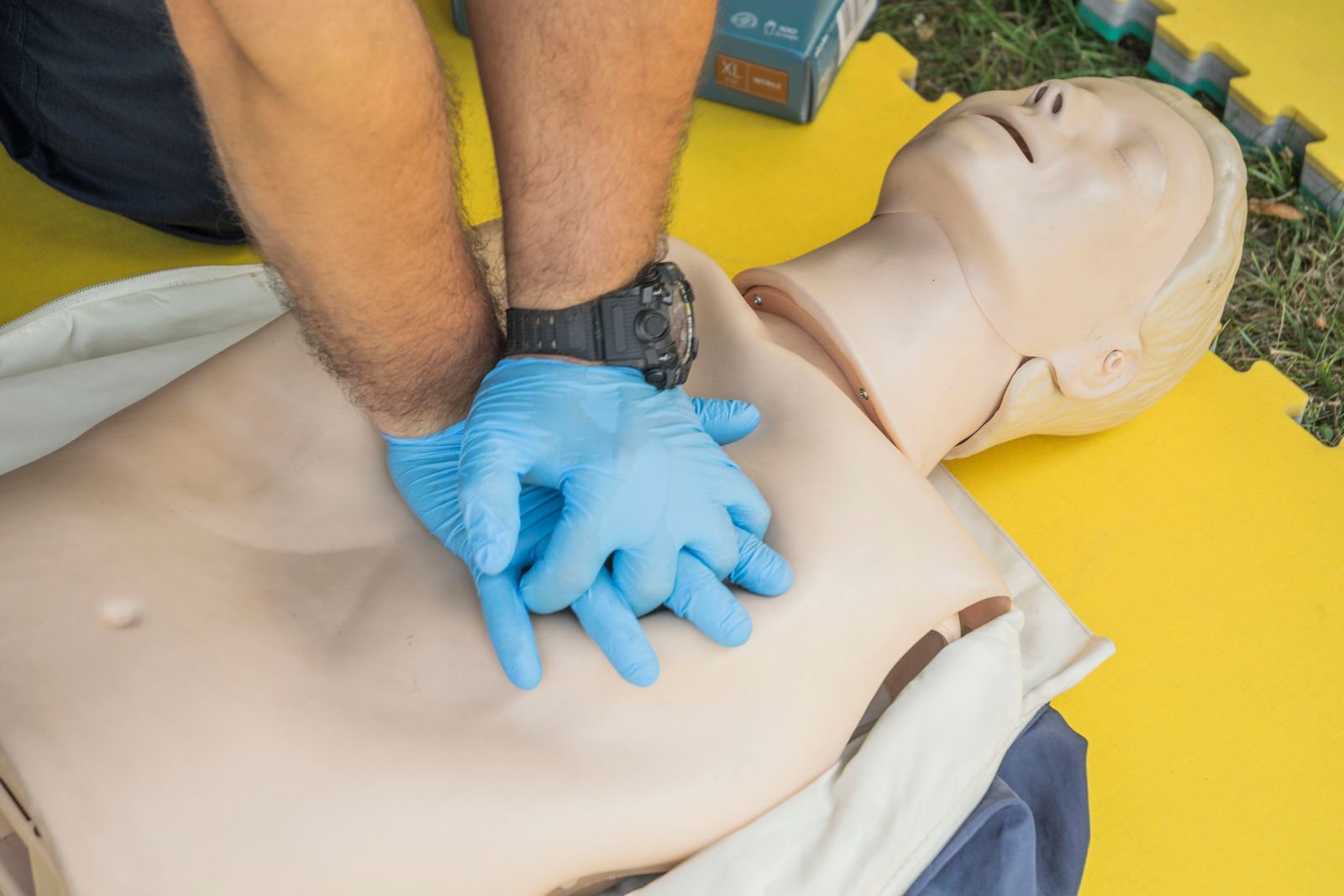
- Compressions: heel of one hand on the centre of the chest, on the lower half of the breastbone, the other hand on top; at least 5 cm deep but not more than 6 cm, at 100 to 120 per minute, letting the chest recoil fully without leaning on it. The casualty should lie on a firm surface where this does not delay compressions. [1]
- Breaths: trained rescuers give 30 compressions to 2 breaths, each breath over about one second. Untrained rescuers, or those unwilling to give breaths, give compressions only. [1]
- Pauses: compressions continue until an AED is applied, pauses before and after a shock are kept as short as possible, and compressions resume immediately after the shock. [1]
Choking: an update that matters in offices
Choking on food during the lunch break is an everyday office scenario. The 2025 guidelines add guidance for conscious adults and children: alternate 5 back blows with 5 abdominal thrusts until the object comes out or the person becomes unresponsive. [2] What to do if the casualty becomes unresponsive is part of the hands-on training every first-aider needs.
Does the office need an AED?
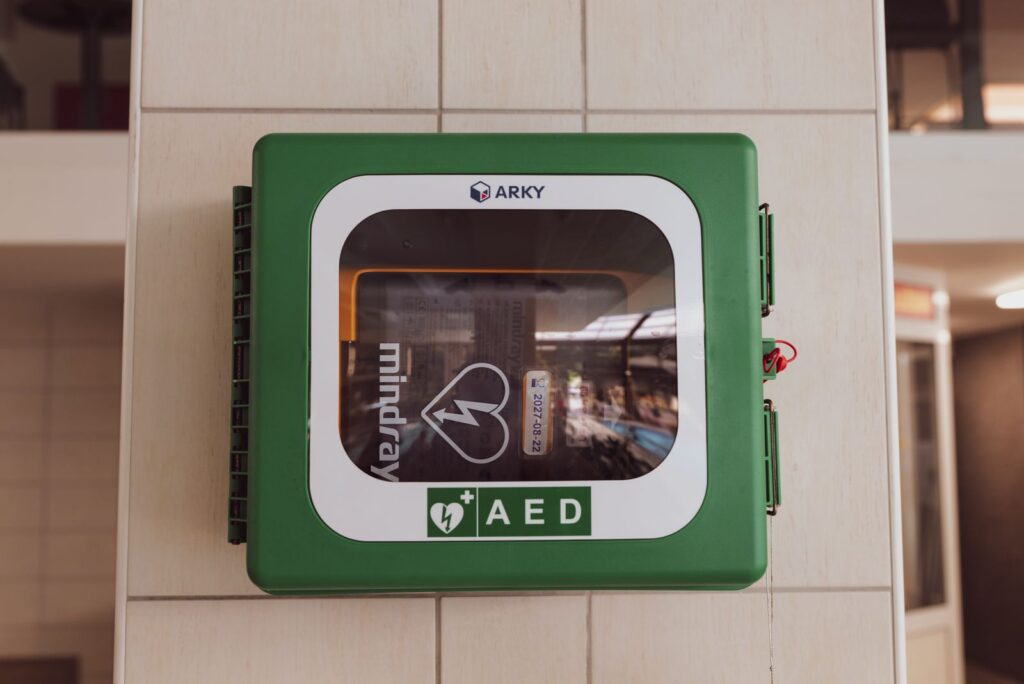
The Sharjah code recommends that entities set up an AED programme in line with the risk assessment or the requirements of the relevant authorities. Where an AED is provided, first-aiders must be trained to use it, it must be kept in a prominent and accessible place, and the manufacturer’s instructions must be followed for inspection and maintenance. [5]
In the UK, AED use is part of the syllabus for both emergency and full first-aid-at-work courses. [4] The practical point: if you buy an AED, tie it to a plan; otherwise it becomes a box on the wall that nobody remembers checking.
How many first-aiders do you really need? A hypothetical example
Hypothetical example: an office in Sharjah with 45 employees on two floors, working a morning and an evening shift.
- The table: headcount is between 17 and 50, so the code’s minimum is two trained first-aiders. [5]
- Shifts: sufficient cover must be available whenever employees are at work, and separate arrangements may be needed for each shift. [4] Two first-aiders who both work mornings are not enough.
- Floors: waiting for a first-aider to arrive from another floor costs time, so one per floor on each shift is better.
- Leave: annual leave is predictable and should be planned for in advance. [4]
A sensible result for this office is at least four trained first-aiders, plus cover for leave, rather than just two. The gap between those two numbers is the gap between paper compliance and real cover.
What level of training does a first-aider need?
HSE guidance distinguishes two levels. Emergency First Aid at Work (EFAW) covers unconsciousness, CPR, AED use, choking, bleeding, shock and minor injuries. First Aid at Work (FAW) adds specific injuries and illnesses, such as burns, chest and spinal injuries, poisoning, anaphylaxis, heart attack and stroke. [4]
In low-hazard offices the emergency level is enough for many first-aiders, but the needs assessment decides. That assessment should also cover visitors and customers: HSE strongly recommends including non-employees in first-aid arrangements, which matters for service centres where staff deal with the public every day. [4] The 2024 revision of the guidance also stresses considering employees’ mental health in the assessment. [4]
Training, renewal and records
A first-aid certificate is not permanent. Under HSE guidance it lasts three years, a first-aider is no longer considered competent once it lapses, and short annual refreshers are strongly recommended because skills fade. [4] The Sharjah code requires refresher training on expiry and no later than two years after the certificate is issued, delivered in a language and format employees understand and paid for by the entity. [5]
The code also requires records of the risk assessment, training, first-aiders’ names and contact details, and first-aid and medical emergency cases. [5] It provides a template for logging each case, covering the casualty, incident details, treatment given, follow-up needs and the first-aider’s sign-off. [5] These records prove the programme is alive, and reviewing them shows where injuries recur and what needs fixing.
- Written, current needs assessment
- First-aiders for every floor and shift
- Cover for leave and absence
- Notice naming first-aiders and kit locations
- Stocked kits, no medicines
- Contents and expiry checked regularly
- AED visible and maintained, if provided
- Valid certificate for every first-aider
- Renewal before expiry
- Log of first-aid cases
- Practical cardiac arrest drill
Conclusion
A trained first-aider in the office is neither a luxury nor just an inspection item. Start with a written needs assessment, cover every floor and shift, renew certificates before they expire, and make the 2025 CPR steps a skill your team practises hands-on, not a poster on the wall.
Frequently asked questions
Is a first-aid kit enough for a small office?
A stocked kit plus an appointed person to manage first-aid arrangements is the minimum in ILO guidance, but the needs assessment and local rules may require a trained first-aider. In Sharjah, for example, the code of practice requires at least one trained first-aider even for entities with fewer than 16 employees. [3, 5]
How deep should chest compressions be for an adult?
At least 5 cm for an average adult, avoiding more than 6 cm, at 100 to 120 compressions per minute, letting the chest recoil fully after each one. [1]
What should an untrained employee do if a colleague is unresponsive and not breathing normally?
Call the emergency services and start chest compressions straight away. The guidelines consider compression-only CPR appropriate for untrained rescuers or those unwilling to give rescue breaths. [1]
How long is a first-aid certificate valid?
It depends on the awarding body and local rules. Under HSE guidance in the UK a certificate lasts three years, with annual refreshers strongly recommended; the Sharjah code requires refresher training on expiry and no later than two years after issue. [4, 5]
Is an automated external defibrillator (AED) mandatory in offices?
That depends on local rules and the risk assessment. The Sharjah code recommends an AED programme and, where an AED is provided, requires first-aiders to be trained in its use and the device to be kept in a prominent, accessible place. [5]
References
- American Heart Association. Part 7: Adult Basic Life Support (2025 AHA Guidelines for CPR and ECC) (2025)
- American Heart Association Newsroom. Updated CPR guidelines tackle choking response, opioid-related emergencies and a revised Chain of Survival (2025)
- International Labour Organization (ILO). First aid (OSH guide for labour inspectors)
- Health and Safety Executive (HSE). First aid at work: Guidance on regulations (L74, 3rd edition, amended 2024) (2024)
- Sharjah Occupational Safety and Health System (spsa.shj.ae). OSHJ-CoP-16 First Aid at Work (Version 1)