- Walking is the largest component of picking time, so cutting time starts with where each SKU is stored rather than how fast people move.
- SKUs are ranked by how often they are picked relative to the space they occupy, not by their monetary value.
- The right picking method depends on the shape of your orders: lines per order, order size and dispatch time.
Where does the time go in a warehouse?
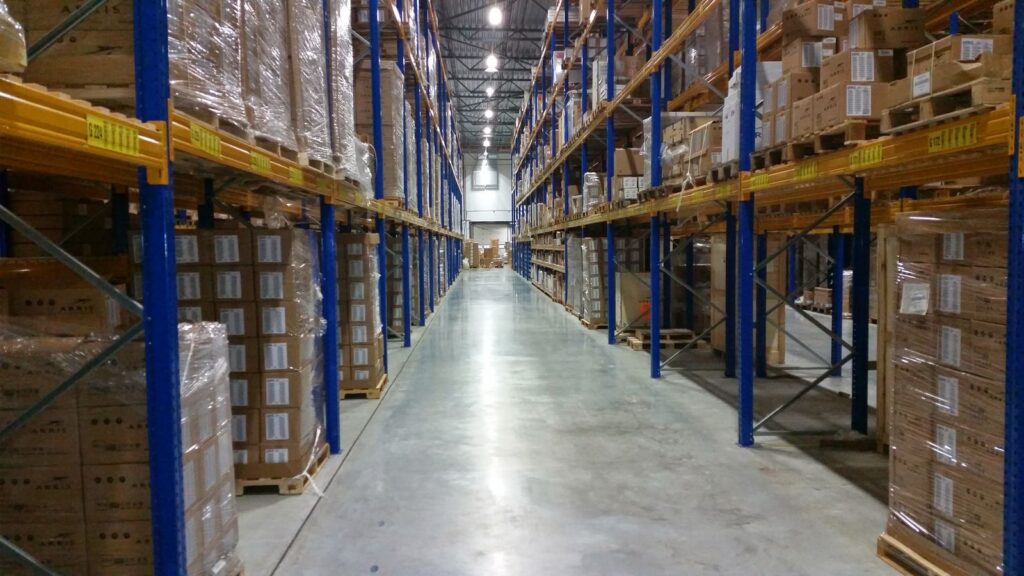
Order picking is the most labour-intensive activity in most warehouses. Typical estimates presented in Warehouse & Distribution Science put picking at about 55% of warehouse operating costs, with travel taking about 55% of picking time and the rest split between searching, extracting the item, paperwork and other tasks. [1]
The practical conclusion is clear: before buying faster equipment or asking pickers to hurry, ask why they walk so far. The answer usually lies in where SKUs are stored and how orders are grouped.
What is slotting?
Slotting is the decision about where each SKU is stored and how much space it gets. The underlying rule is that where you put a product largely determines how quickly and cheaply it can be retrieved later. [1]
There are three main options:
- Dedicated storage: each SKU has a reserved location, so pickers learn the layout and fast movers can sit in convenient places, but space use is poor because a location stays reserved when stock is low. [1, 3]
- Shared storage: any SKU can occupy any free location, so less space is needed, but a warehouse management system (WMS) must direct pickers to each location. [1, 3]
- Class-based storage: SKUs are grouped into three to five classes by frequency of access, each class has its own zone, and storage within a zone is shared. It is a common middle ground. [3]
How should you analyse your data before moving anything?
Start from the order history in your system, not from supervisors’ impressions. For each SKU, extract the number of picks (order lines it appeared on) over a period that represents your business, then work out how many locations it needs.
Three points before you analyse:
- Count picks, not units: a SKU that ships 1,000 units on one order needs one visit; a SKU that ships 100 units across 100 orders needs a hundred.
- Exclude one-off orders: a single project shipment can inflate the movement of a SKU that is rarely ordered.
- Separate seasonal SKUs: an item that moves heavily for one month a year needs a seasonal plan, not a permanent prime location.
You will usually find that a small number of SKUs accounts for most picks, while the slow movers are numerous and take up most of the space. [1] That skew is what makes slotting worthwhile.
The better criterion is not picks alone but picks relative to the space required. One established assignment method divides demand by the number of storage locations a SKU needs, ranks SKUs in descending order and gives the top ones the locations with the shortest travel time, an idea close to the cube-per-order index introduced by Heskett. [3]
- 1Extract movement dataNumber of picks per SKU
- 2Calculate picks per spacePicks ÷ locations required
- 3Classify SKUsThree to five classes
- 4Rank locationsClosest, easiest for the top class
- 5Move and measureSmall batches, before-and-after KPIs
Note that this classification is by movement, not the value-based ABC analysis used for stock counts. An expensive item that is rarely ordered does not deserve a close location.
The forward-pick area and replenishment
Many warehouses set aside a small, easily reached area for picking, such as carton flow rack or the ground level of pallet racking, and replenish it from reserve stock. [2]
The harder question is which SKUs go into that area, and in what quantity. The answer is not simply “the most popular”. A SKU ordered in large quantities needs frequent restocking, and restocking is work whose cost must be counted alongside picking. [2] A single restock usually costs more than a single pick, because the restocker handles bulk units and prepares them for picking. [1]
A common mistake is giving every SKU equal space, or storing the same time supply of each (three weeks, say). Bartholdi shows that these two approaches generate the same total restocking work, and that an allocation calculated from each SKU’s movement can do considerably better. [2]
The right height: safety before speed
Horizontal distance is not the whole story. The level a SKU is stored on affects both picking speed and the picker’s safety.
Guidance from the UK Health and Safety Executive (HSE) advises avoiding lifting from floor level or above shoulder height, especially for heavy loads, and reducing twisting, stooping and reaching. In its lifting filter, guideline weights are highest around elbow and knuckle height and fall at shoulder and lower-leg height. [4]
So place heavy and fast-moving SKUs on the middle levels, and keep the top and bottom levels for light or slow-moving items. Each Gulf state applies its own occupational safety requirements, so check with the competent authority in your country when setting weight limits.

Picking methods: which suits your orders?
Once locations are set, you decide how orders are assembled. The choice depends on lines per order, order size and dispatch time.
| Method | Suits | Advantage | Challenge |
|---|---|---|---|
| Discrete | Medium or large orders | No sorting or coordination | More walking per line |
| Batch | Many small orders | One trip serves several orders | Sorting after picking |
| Zone | High volume, small items | Pickers know their zone | Balancing work across zones |
- Discrete picking: one picker collects a whole order, so there is no need to coordinate pickers or assemble order parts. [1]
- Batch picking: several orders are collected in one trip. Single-line orders are excellent candidates because they need no sorting, very large orders need no batching, and medium-sized orders are the hardest case. [1]
- Zone picking: the warehouse is divided into zones with their own pickers, and each order passes from zone to zone until complete. Orders leave in the sequence they were released and pickers build expertise in their area, but the work must be balanced like an assembly line. [1]
Splitting a large order across several pickers speeds it up, but the parts must be consolidated before shipping. [1] Sequencing pick-list lines along the walking route, a standard WMS function, also stops pickers doubling back to an aisle they have already passed. [1]
Hypothetical example: two SKUs with the same demand
A distribution warehouse in a free zone holds two SKUs, each picked 300 times a month. SKU A is small packs that fit in one slot; SKU B is large cartons that need four slots.
Picks per slot are 300 ÷ 1 = 300 for A and 300 ÷ 4 = 75 for B. So A takes the closest slot on the main aisle at waist height, and B moves slightly further away to the ground level of the pallet racking. That close slot now serves 300 picks rather than 75.
KPIs to track after re-slotting
Do not judge the change by impression. Record values before and after the move over the same period. Key warehouse efficiency KPIs highlighted by ASCM include: [5]
| KPI | What it reveals |
|---|---|
| Picks per hour | The direct effect of less walking |
| Order accuracy | Whether moves caused picking errors |
| Replenishments | Whether feeding the pick area became costlier |
| Inventory accuracy | Whether system locations match reality |
| Order fulfilment timeliness | From order placement to dispatch |
Move SKUs in small batches, and update locations in the system before the physical move, so you do not lose the inventory accuracy you have built.
Conclusion
Cutting picking time starts with data: what is ordered often, how much space it needs and how orders arrive. Put the SKUs with the most picks per slot in the closest and safest locations, count restocking alongside picking, choose a picking method that matches your order profile, and measure the result before scaling up.
Frequently asked questions
What is the difference between dedicated and shared storage?
Dedicated storage reserves a location for each SKU for the whole period, which is easy to learn but leaves space idle when stock runs low. Shared storage lets any SKU use any free location, which saves space but needs a system to direct pickers to it. [1, 3]
Should the most valuable SKUs get the closest locations?
No. The criterion is how often a SKU is picked compared with the space it needs, so a cheap, small, fast-moving item deserves a close location more than an expensive item that is rarely ordered. [3]
How often should a warehouse be re-slotted?
There is no fixed interval; review the fast movers whenever the demand pattern changes noticeably, for example when new SKUs arrive or before peak seasons, and move a limited number of SKUs each time rather than re-arranging the whole building.
When does batch picking make sense?
When there are many small orders. Single-line orders are good candidates because they need no sorting afterwards, while very large orders are picked on their own. [1]
Which KPIs show that re-slotting worked?
Compare picks per hour, order accuracy and the number of replenishments before and after the change, using the same data and the same length of period. [5]
References
- John J. Bartholdi III & Steven T. Hackman, Georgia Institute of Technology. Warehouse & Distribution Science (Release 0.98) (2017)
- John J. Bartholdi III, Georgia Institute of Technology. Slotting the forward-pick area of a warehouse
- Georgia Institute of Technology, School of Industrial and Systems Engineering. Logistics Systems Design, Chapter 20: Storage Systems
- Health and Safety Executive (HSE). Manual handling at work: A brief guide (INDG143 rev4) (2020)
- ASCM (Association for Supply Chain Management). 8 KPIs for an Efficient Warehouse (2022)
Recommended programmes