- The five moments define when hands must be cleaned around a patient: before touching them, before a clean procedure, after body fluid exposure risk, after touching them and after touching their surroundings.
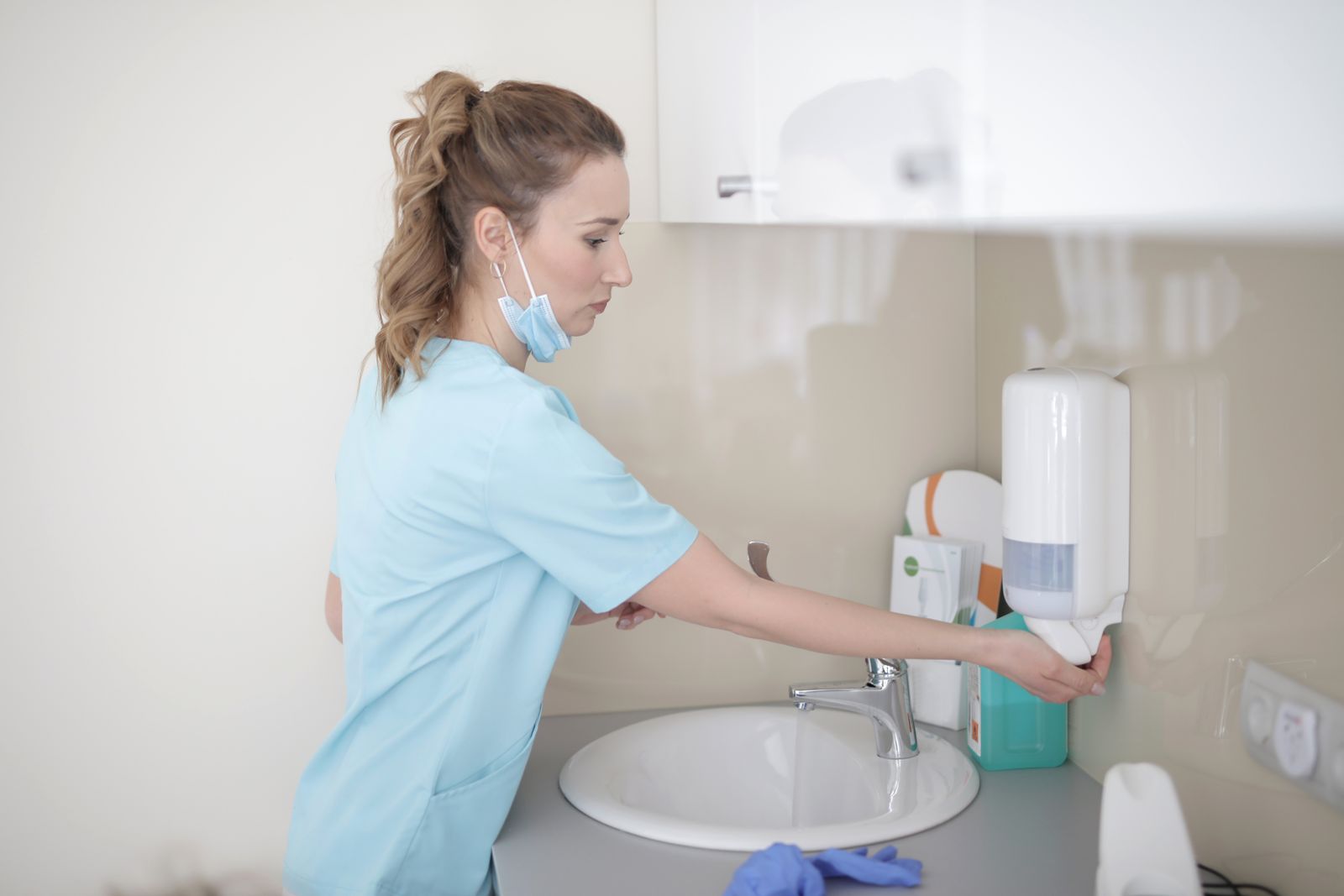
- Alcohol-based handrub is the preferred method for routine hand hygiene; soap and water are needed when hands are visibly soiled, after using the toilet and when spore-forming pathogens are suspected.
- Gloves never replace hand hygiene, and compliance is measured by observed opportunities, not by headcount.
This article is for professional awareness; the binding reference is your facility's infection prevention and control policy and the requirements of your national health regulator.
What are the five moments, and why are they built around the patient?
The five moments for hand hygiene form part of the WHO guidelines on hand hygiene in health care, published in 2009. The guidelines are aimed at health workers, hospital managers and health authorities, and apply wherever care is delivered, from hospitals to home care. [1]
The framework divides the workplace into two areas. The patient zone is the patient plus the surfaces and items they touch or that touch them, such as bed rails, the bedside table, bed linen, infusion tubing and monitors; it moves with the patient wherever they go. The health-care area is everything outside that patient’s zone, including other patients’ zones. [3]
The idea is simple: each moment sits at a boundary where germs can cross, either from the environment to the patient, or from the patient to the worker and the rest of the facility. WHO notes that healthcare-associated infections affect about one patient in ten on average, and that infection prevention and control interventions cut these infections and antimicrobial resistance by 35% to 70%. [5]
- 11. Before touching a patientProtects the patient from your hands
- 22. Before a clean procedureProtects critical sites from infection
- 33. After body fluid riskProtects you and the environment
- 44. After touching a patientWhen leaving the patient's side
- 55. After touching surroundingsEven without touching the patient
The five moments in detail: when, and whom they protect
- Before touching a patient: when approaching them for any contact, such as personal care, a non-invasive examination or fitting an oxygen mask. This protects the patient from germs carried on your hands. [2, 3]
- Before a clean or aseptic procedure: immediately before touching a critical site, such as a mucous membrane, non-intact skin or an invasive device. This protects the patient from germs entering their body, including their own. [2, 3]
- After body fluid exposure risk: as soon as the task is finished and after removing gloves, for example after contact with body fluids, removing an invasive device or handling soiled linen. This protects you and the care environment. [2, 3]
- After touching a patient: when leaving their side after any contact. [2]
- After touching patient surroundings: when leaving after touching anything in their immediate surroundings, even if you did not touch the patient. [2]
Handrub or soap and water?
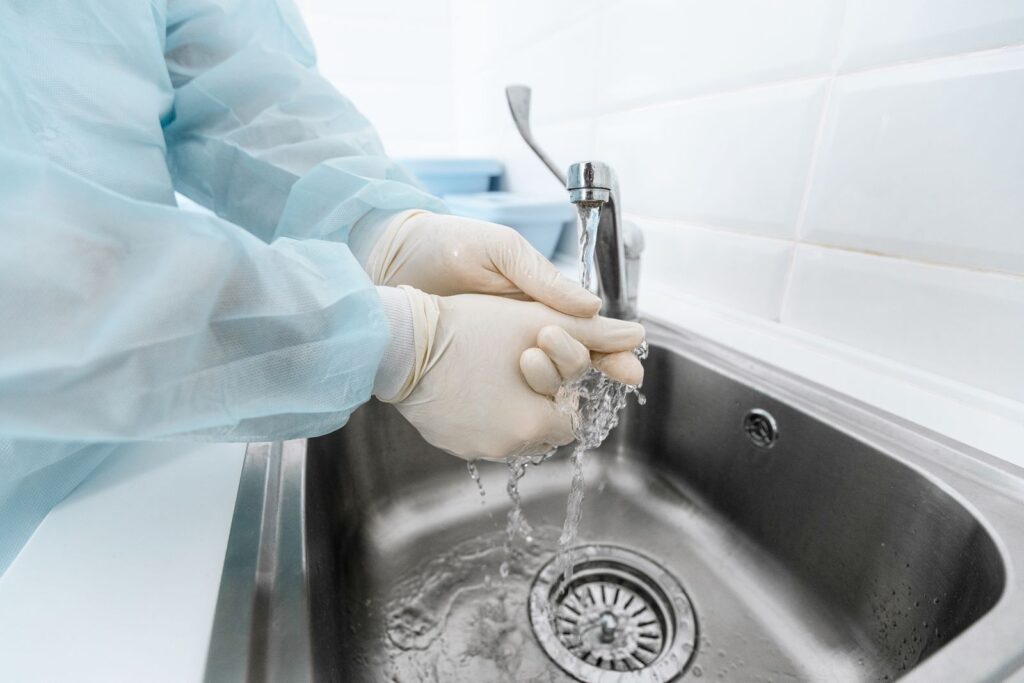
Alcohol-based handrub is the preferred method for routine hand hygiene as long as hands are not visibly soiled; the whole procedure takes 20 to 30 seconds, until the hands are dry. Washing with soap and water takes 40 to 60 seconds. [2]
| Item | Alcohol-based handrub | Soap and water |
|---|---|---|
| Whole procedure | 20–30 seconds | 40–60 seconds |
| When to use | Routine hand hygiene, hands not soiled | Visibly soiled, blood or body fluids |
| Special cases | Not enough for spore-forming germs | After the toilet; C. difficile outbreaks |
Washing becomes mandatory in three situations: when hands are visibly dirty or soiled with blood or other body fluids, after using the toilet, and when exposure to spore-forming pathogens is strongly suspected or proven, as in outbreaks of Clostridioides difficile (formerly Clostridium difficile). [2]
The guidance also says that artificial nails or extenders should not be worn during direct patient contact, and that natural nails should be kept short. [2] Other details, such as jewellery, watches and sleeves, vary according to each facility’s policy and its regulator.
Gloves do not cancel hand hygiene
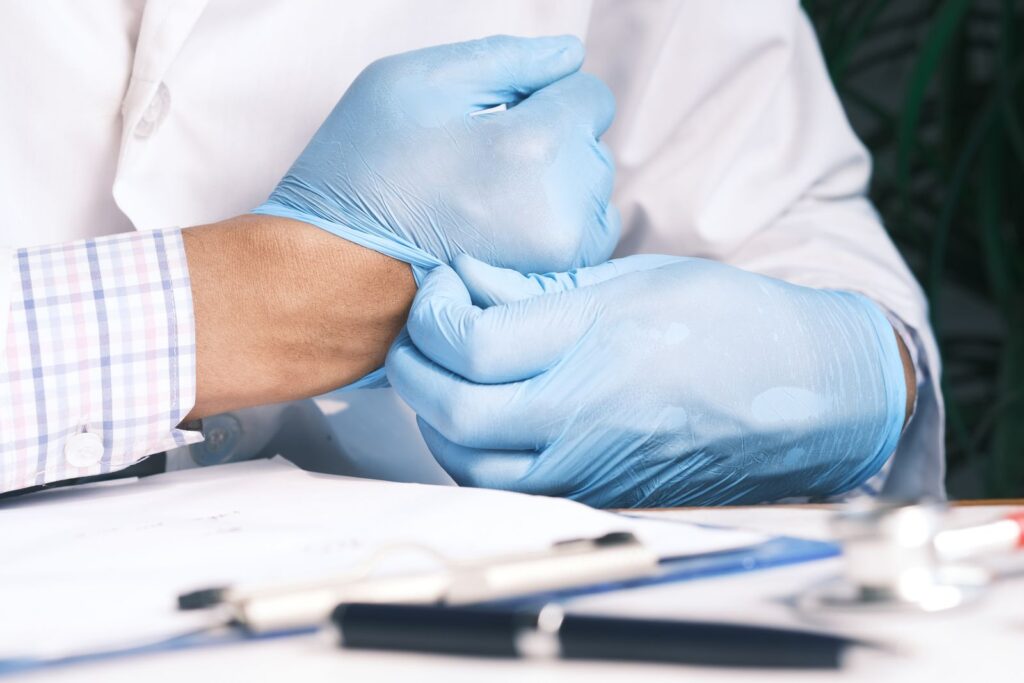
A common mistake on wards is treating gloves as a substitute for hand hygiene. Gloves do not replace hand cleaning, and hand hygiene is required at every moment whether or not gloves are worn. [2]
- Clean your hands before putting on gloves for a task that requires them, and after removing them. [3]
- If a moment arises while you are wearing gloves, remove them, clean your hands and put on a fresh pair if needed. [2, 3]
- Discard gloves after each task, because they can carry germs. [2]
- Wear gloves only when standard or contact precautions call for them, because unnecessary use increases the risk of transmitting germs. [2]
Practical scenarios: which moment applies?
This table helps trainers and supervisors turn the moments into situations the team recognises:
| Situation | Moment |
|---|---|
| You enter the room to adjust an oxygen mask | 1 Before touching a patient |
| You prepare to draw blood from an intravenous catheter | 2 Before a clean procedure |
| You remove gloves after emptying a urine bag | 3 After body fluid exposure risk |
| You leave after taking a blood pressure reading | 4 After touching a patient |
| You adjust an infusion pump and leave without touching the patient | 5 After touching surroundings |
| You move directly from one patient to another | One action covers moment 4 for the first and moment 1 for the second |
The rule in the last row is that a single action is enough when it falls directly between two contacts, because an opportunity is counted by the number of hand hygiene actions required, not by the number of moments. Moments 4 and 5, however, can never be combined: either you touched the patient or you touched only their surroundings. [3]
How do you measure compliance on a ward?
Measurement relies on direct observation. The observer records opportunities, an opportunity existing whenever at least one moment requires hand hygiene, and then records whether the action was performed. Compliance is calculated as follows: [3]
Compliance = (hand hygiene actions performed ÷ observed opportunities) × 100
The WHO technical manual sets rules that make the figure reliable: [3]
- Collect at least 200 opportunities per unit (a ward or a professional group) in each observation period.
- Keep observation sessions to about 20 minutes, and observe no more than three health workers at once.
- Record only what you see; never assume that an action or a moment occurred.
- Do not observe during emergency treatment or when a worker is visibly under stress, as these do not reflect routine care; this does not rule out observation on emergency and intensive care wards themselves.
- Keep data confidential, do not use it for administrative appraisal of individuals, and give the team feedback as soon as possible.
Hypothetical example: an infection control supervisor on a medical ward observes 200 opportunities over a month, and hand hygiene is performed in 150 of them, giving a compliance rate of 75%. Broken down by moment, most of the misses are at moment 5, after touching the bed and the pump. The intervention becomes specific: focused awareness on the patient’s surroundings, and handrub dispensers placed at the door and at the bedside.
Why is training alone not enough?
WHO recommends a multimodal strategy made up of five components that work together: [4]
- System change: handrub at the point of care, plus water, soap and towels.
- Training and education: for everyone who has contact with the patient and their surroundings.
- Evaluation and feedback: measuring compliance and reporting results to teams.
- Workplace reminders: posters and prompts at the point of care.
- Institutional safety climate: management commitment and the involvement of patients and staff.
The first component is a precondition for the rest: WHO notes that half of the world’s healthcare facilities still lack basic hand hygiene facilities at the point of care. [5] A member of staff who has to walk to the end of the corridor to find handrub will skip some moments, however good their training.
What about requirements in the Gulf?
Whether the WHO framework is mandated, and how it is applied, differs from one Gulf country to another. In Saudi Arabia, the Ministry of Health launched a national hand hygiene programme in 2009, and in 2019 a Council of Ministers decision made hand hygiene mandatory for health practitioners and required facilities to use WHO tools to measure compliance. Every facility must have at least one hand hygiene coordinator, and more than 2,100 coordinators were registered in the first quarter of 2022. [6]
In other countries, check the policy of the health authority that licenses your facility, as details such as jewellery, audit frequency and reporting may differ.
Conclusion
The five moments turn “wash your hands” into clear rules tied to the patient zone: two moments before contact to protect the patient, and three after it to protect you and the facility. Put handrub at the point of care, train the team on real situations, measure compliance by observed opportunities, and then target improvement at the weakest moment.
Frequently asked questions
What are the five moments for hand hygiene?
Before touching a patient, before a clean or aseptic procedure, after body fluid exposure risk, after touching a patient, and after touching the patient's surroundings even if the patient was not touched. [2]
How long should handrubbing and handwashing take?
WHO recommends 20 to 30 seconds for the whole handrub procedure and 40 to 60 seconds for the whole handwash procedure with soap and water. [2]
Do gloves replace hand hygiene?
No. Clean your hands before putting gloves on and after removing them; if a moment arises while you are wearing gloves, remove them and clean your hands. [2, 3]
How is hand hygiene compliance calculated?
Hand hygiene actions performed divided by observed opportunities, multiplied by 100. The WHO manual recommends at least 200 opportunities per unit in each observation period. [3]
Do the five moments apply only to nurses?
No. They apply to everyone who has contact with the patient or their immediate surroundings, from doctors and nurses to radiographers, physiotherapists and cleaning staff.
References
- World Health Organization. WHO guidelines on hand hygiene in health care (2009)
- World Health Organization. Hand Hygiene: Why, How & When? (2009)
- World Health Organization (copy hosted by Medbox). Hand Hygiene Technical Reference Manual (2009)
- World Health Organization. A guide to the implementation of the WHO multimodal hand hygiene improvement strategy (2009)
- World Health Organization. World Hand Hygiene Day: Key facts and figures
- Ministry of Health, Kingdom of Saudi Arabia. WHO Celebrates Hand Hygiene Success in the Kingdom (2022)